
Research feature
Release date
Antcin A:
Cell and mouse studies investigate NLRP3, with less liver lipid deposition and inflammation observed
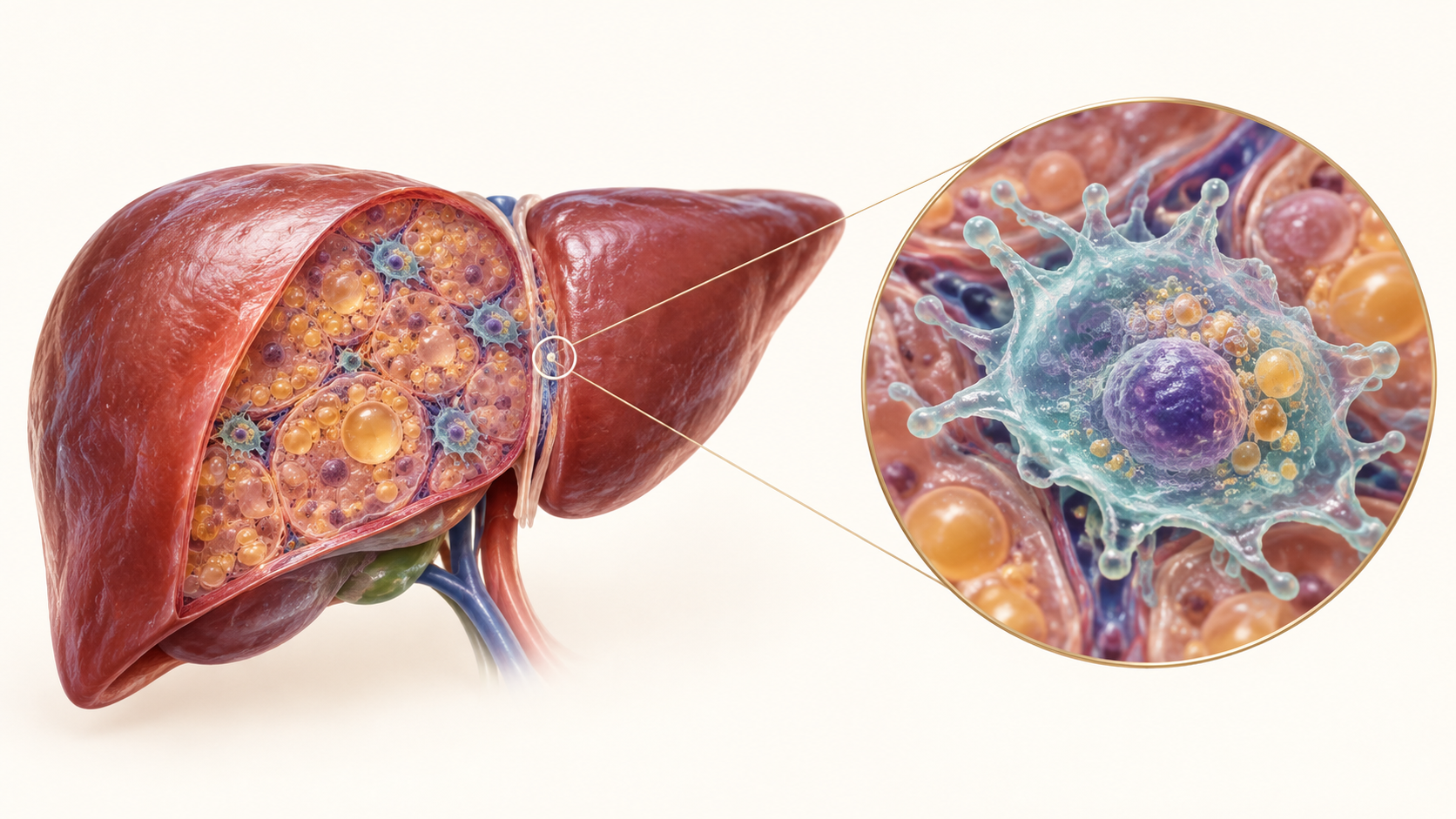
Cell and mouse studies of Antcin A offer a promising direction to investigate for fatty liver treatment. A 2021 study of non-alcoholic fatty liver disease (NAFLD) reported less liver lipid deposition, reduced inflammation and lower ALT/AST in high-fat-diet mice, together with mechanistic findings involving the NLRP3 inflammasome.[1,2]
Research observations: less lipid deposition and inflammation
Improving liver fat accumulation and its associated pathological changes is a key goal in fatty liver treatment. In a 2021 International Immunopharmacology study, high-fat-diet fatty liver mice receiving Antcin A showed less liver lipid deposition and tissue inflammation, together with lower blood ALT/AST levels.[1,2]
For indication assessment, these measurable pharmacological endpoints provide specific preclinical support for investigating Antcin A’s fatty liver treatment potential. Further studies can test whether the effects are reproduced across disease stages and dosing conditions.
Less lipid deposition
Reduced lipid accumulation in mouse liver.
Less inflammation
Reduced inflammatory responses in mouse liver tissue.
Lower ALT / AST
Improved blood markers associated with liver injury.
NLRP3 inhibition: an anti-inflammatory approach to fatty liver research
The same study investigated Kupffer cells, the liver’s resident immune cells. The authors reported that Antcin A bound to NLRP3, inhibited inflammasome assembly and activation, and reduced pyroptosis and inflammatory responses. Pyroptosis is an inflammatory form of cell death. These findings provide a testable mechanistic approach for fatty liver pharmacology research.[1,2]
GR nuclear translocation provides a separate, complementary lead. A 2011 A549 cell study observed Antcin A inducing glucocorticoid receptor (GR) movement from the cytoplasm into the nucleus.[3] Whether GR contributes to NLRP3 inhibition in the fatty liver study remains a question for dedicated experiments.
Mechanistic leads
2021 | Kupffer cell study [1,2]
NLRP3 inflammasome
- Antcin A binds to NLRP3
- Reduced inflammasome assembly and activation
- Reduced pyroptosis and inflammatory responses
2011 | A549 cell study [3]
GR nuclear translocation
An observed change in receptor location provides a lead for GR-related mechanisms.
The studies used different models; investigating their relationship is a direction for further mechanistic work.
Comparison with existing treatments: what could Antcin A add?
Existing medicines can improve steatohepatitis or fibrosis. This comparison uses two representative US-approved treatments for adults with noncirrhotic MASH and F2–F3 fibrosis. MASH is metabolic dysfunction-associated steatohepatitis.[4,5]
In the 72-week analysis of the Wegovy trial, 63% achieved MASH resolution without worsening fibrosis, and 37% achieved fibrosis improvement without worsening MASH; placebo rates were 34% and 22%, respectively. From a development perspective, these established effects also leave room to investigate broader treatment responses.[5]
| Medicine / research molecule | Main mechanistic approach | Evidence and development relevance |
|---|---|---|
| Rezdiffra (resmetirom) | Activates hepatic THR-β to reduce intrahepatic triglycerides.[4] | Human evidence of MASH and fibrosis improvement establishes a clinical benchmark for targeting liver lipid metabolism. |
| Wegovy injection (semaglutide) | GLP-1 receptor agonism. Weight loss and other factors contribute to MASH improvement; the precise mechanism remains under investigation.[5] | Human evidence of MASH and fibrosis improvement; its liver benefits include effects on inflammation and fibrosis. |
| Antcin A | Preclinical studies focus on NLRP3, Kupffer cells and pyroptosis.[1,2] | Cell and mouse findings offer another immune-inflammatory approach for testing additional or complementary effects. |
Rezdiffra (resmetirom)
- Main mechanistic approach
- Activates hepatic THR-β to reduce intrahepatic triglycerides.[4]
- Evidence and development relevance
- Human evidence of MASH and fibrosis improvement establishes a clinical benchmark for targeting liver lipid metabolism.
Wegovy injection (semaglutide)
- Main mechanistic approach
- GLP-1 receptor agonism. Weight loss and other factors contribute to MASH improvement; the precise mechanism remains under investigation.[5]
- Evidence and development relevance
- Human evidence of MASH and fibrosis improvement; its liver benefits include effects on inflammation and fibrosis.
Antcin A
- Main mechanistic approach
- Preclinical studies focus on NLRP3, Kupffer cells and pyroptosis.[1,2]
- Evidence and development relevance
- Cell and mouse findings offer another immune-inflammatory approach for testing additional or complementary effects.
Additional efficacy, combination use and safety are research questions to test. Differences in study stages, populations and endpoints prevent direct cross-trial efficacy ranking.
Add an immune target
Investigate control of inflammation and pyroptosis through NLRP3 and Kupffer cells.
Broaden treatment response
Test additional benefit in research settings with persistent inflammation or liver injury after treatment.
Explore combinations
Use preclinical combination experiments to assess whether effects complement existing treatments.
A specific direction for evaluating a future drug indication
From a drug development perspective, the study connects fatty liver treatment potential with specific research subjects: NLRP3, liver immune cells, and lipid deposition and inflammation endpoints. This makes Antcin A a molecule worth evaluating further for fatty liver and provides a clearer starting point for exploring future human drug indications.
For TFA, these publications can inform fatty liver indication assessment. Pursuing this indication would require confirming pharmacological effects and dose in relevant disease models, together with drug exposure, formulation and long-term safety data, before assessing clinical research feasibility.
This feature focuses on published preclinical fatty liver research. Human efficacy and long-term safety require dedicated studies. The 2021 paper should be read with its 2022 corrigendum.[1,2]
Sources and research references
- [1] Ruan S et al. (2021). Antcin A alleviates pyroptosis and inflammatory response in Kupffercells of non-alcoholic fatty liver disease by targeting NLRP3. International Immunopharmacology 100:108126.
- [2] Ruan S et al. (2022). Corrigendum to the NLRP3 study. International Immunopharmacology 104:108485.
- [3] Chen YC et al. (2011). Antcin A, a steroid-like compound from Antrodia camphorata, exerts anti-inflammatory effect via mimicking glucocorticoids. Acta Pharmacologica Sinica 32:904–911.
- [4] US FDA. Rezdiffra (resmetirom) prescribing information. Revised July 2026. Sections 1, 12.1 and 14.
- [5] DailyMed. Wegovy (semaglutide) prescribing information. Updated June 18, 2026. Sections 1, 12.1 and 14.4.
About TFA
TFA Therapeutics, Inc. (OTCQB: RAJAF) is developing TFA-01, an Antcin A-based drug candidate, with canine osteoarthritis as its initial target indication. The program includes source material and formulation development, as well as safety and efficacy evaluation.
Forward-looking statements: The development plans described in this release may change in response to study results, regulatory requirements, and funding arrangements. Actual progress and outcomes may differ from current expectations.