Long-term treatment requires more than efficacy alone
Chronic inflammatory conditions require ongoing management. TFA aims to develop a new treatment option and evaluate its potential for repeated use.

TFA EVIDENCE LIBRARY
Explore the basis for TFA-01 development, from published research on Antcin A’s mechanism to preliminary company studies, formal research plans, and related technology patents.
01 · Therapeutic Rationale & Scientific Evidence
Corticosteroids have well-established therapeutic value, but the challenges of repeated or prolonged use create demand for new treatments. TFA-01 is an Antcin A-based drug candidate being studied for its potential to provide anti-inflammatory activity with an improved long-term benefit-risk profile.
Chronic inflammatory conditions require ongoing management. TFA aims to develop a new treatment option and evaluate its potential for repeated use.
A 2011 cell study reported that Antcin A induced nuclear translocation of the glucocorticoid receptor (GR)—movement of the receptor from the cytoplasm into the nucleus.
Read the original studyPreliminary in vitro research by Dr. Huang’s team observed anti-inflammatory signals, supporting further work on dosing, formulation, safety, and canine OA.
GR nuclear translocation and in vitro findings support further development; potential as an alternative to corticosteroids requires validation in formal studies.
Explore the scientific evidencePreclinical research does not establish clinical benefit, and patents do not imply drug approval. Each item states its limits.
HOW TO READ THE EVIDENCE
The 2011 GR nuclear translocation study provides a starting point. TFA is building on preliminary in vitro findings and canine observations to advance formal safety, formulation, and clinical studies.
Antcin A, Antcin K and Antrocin are different compounds. Findings for one cannot be applied to another.
General cell models, Caco-2 absorption models, animal studies, and human evidence represent different levels; each publication is labeled accordingly.
Mechanistic signals are not described as clinical benefit, and exploratory findings are not described as approved uses.
DEVELOPMENT EVIDENCE MAP
Each of the five development workstreams identifies the available evidence and what remains to be verified.
Published studies support GR/GRα-related signaling by Antcin A in defined models. TFA is assessing how those findings apply to its current test articles, batches and canine OA development program.
Next milestoneComplete candidate test-article and batch definition and strengthen program-level pharmacology relevant to canine osteoarthritis.LimitationsAvailable studies do not establish direct biochemical binding between Antcin A and GR, canine or human clinical efficacy, program-specific pharmacokinetic parameters, or drug approval.View progress detailsResearch on strains from multiple sources and their Antcin A content supports controlled cultivation, strain selection, purification, analytical testing and formulation development.
Next milestoneComplete physicochemical validation of the nanoformulation, then advance formal specifications, batch consistency and process scale-up.LimitationsFormal specifications, COAs, batch consistency, commercial scale-up and GMP validation are not complete. The nanoformulation remains under physicochemical validation, and final formulation specifications have not yet been established.View progress detailsA 14-day repeat-dose preliminary toxicology study in female rats is complete and a report is available to inform later study design. The Graduate Institute of Animal Vaccine Technology is advancing target-animal safety, toxicology, residue and formulation-related research.
Next milestoneComplete the subsequent regulatory toxicology reports and establish the safe dose range for the purified candidate drug substance and final product under this development program.LimitationsThe preliminary screen was not GLP regulatory toxicology or a long-term safety study. It does not establish canine safety, long-term safety, or the safety of purified Antcin A or a final product.View progress detailsTFA completed uncontrolled exploratory observations in 15 dogs. The first-stage canine osteoarthritis research agreement has been signed, and preliminary cell-based testing is underway ahead of a standardized study.
Next milestoneComplete the canine OA study under a protocol with prespecified endpoints and a statistical analysis plan, and prepare the study report.LimitationsThe 15-dog internal exploration was not a regulatory study and lacks verifiable formal start and end dates, a full protocol, prespecified endpoints, statistical analysis and a signed report. It does not establish efficacy, safety, equivalence or superiority. Launching the later research collaboration is not the same as study completion or a new conclusion.View progress detailsTFA is assembling data for a veterinary drug application in Taiwan and planning its U.S. CVM strategy. Partnership and licensing opportunities will be evaluated as the supporting data develop.
Next milestoneObtain regulatory feedback on study design, process specifications and remaining data gaps, then develop a submission plan.LimitationsRegulatory acceptance of the data, acceptance of the application for review, drug approval, launch timing and commercial outcomes remain uncertain.View progress detailsCORE PUBLISHED LITERATURE
Six core studies, ordered by year and evidence level.
Chen YC et al. Antcin A, a steroid-like compound from Antrodia camphorata, exerts anti-inflammatory effect via mimicking glucocorticoids. Acta Pharmacologica Sinica. 32(7):904–911. DOI 10.1038/aps.2011.36.
Wang Q et al. Intestinal Absorption of Ergostane and Lanostane Triterpenoids from Antrodia cinnamomea Using Caco-2 Cell Monolayer Model. Natural Products and Bioprospecting. 5(5):237–246. DOI 10.1007/s13659-015-0072-4.
Kumar KJS et al. MicroRNA-708 activation by glucocorticoid receptor agonists regulate breast cancer tumorigenesis and metastasis via downregulation of NF-κB signaling. Carcinogenesis. 40(2):335–348. DOI 10.1093/carcin/bgz011.
Kumar KJS et al. Antcin-A Modulates Epithelial-to-Mesenchymal Transition and Inhibits Migratory and Invasive Potentials of Human Breast Cancer Cells via p53-Mediated miR-200c Activation. Planta Medica. 85(9–10):755–765. DOI 10.1055/a-0942-2087.
Kumar KJS et al. Antcins from Antrodia cinnamomea and Antrodia salmonea Inhibit Angiotensin-Converting Enzyme 2 (ACE2) in Epithelial Cells. Plants. 10(8):1736. DOI 10.3390/plants10081736.
Yang X et al. Structure and Anti-Inflammatory Activity Relationship of Ergostanes and Lanostanes in Antrodia cinnamomea. Foods. 11(13):1831. DOI 10.3390/foods11131831.
Used to inform later formal study design.
COMPANY-REPORTED PRELIMINARY SAFETY DATA
The company has completed a preliminary 14-day repeat-dose toxicology study of TF-15 in female rats and received the report. Test-article and batch bridging to current TFA-01 remains incomplete.
Formal regulatory toxicology continues
Mortality, appearance and visible clinical signs
Before and during the study
BUN, AST and ALT
Gross exam, organ weights and histopathology
Within the study’s limited 14-day assessment, the report held by the company recorded no deaths, abnormal clinical signs or clear adverse findings related to the test article.
The findings inform dose selection for later formal studies; they do not establish long-term safety or safety in other species.
The preliminary 14-day repeat-dose study is complete and its report is available to inform later dose selection. Comparability with current TFA-01 test articles and the suitability of the data for regulatory use require further assessment.
This 14-day screen in 24 female rats used limited endpoints. It was not GLP regulatory toxicology or a long-term safety study and does not establish canine safety or the safety of purified Antcin A drug substance or the final product. Formal toxicology, residue and target-animal safety work continues.
Source: Preliminary toxicology report held by the company. This page presents a public summary and the study’s limitations.EXTERNAL SOURCING REFERENCE
International suppliers offer research-grade Antcin A in small milligram packs. The data below illustrate only the external sourcing barrier and are presented separately from TFA’s supply scale.
Research-reagent list prices illustrate only the external sourcing barrier. TFA’s supply capability and process status are described separately in the CMC section.
List prices were checked on August 17, 2026. The two products have different purity levels, and per-unit prices decline at larger pack sizes; they should not be directly compared or linearly extrapolated. They do not represent industrial or GMP bulk purchase prices, product selling prices, inventory value, revenue or company valuation.
Detailed capacity calculations, process parameters and commercial scenarios are available in the Data Room under NDA.
INTELLECTUAL PROPERTY
The portfolio covers cultivation methods and porous-carrier technology. Refer to official registers for patent ownership, legal status and patent-family relationships.
TFA exercises relevant platform rights under the publicly filed cooperation agreement. Patents do not establish TFA-01 efficacy or approval.
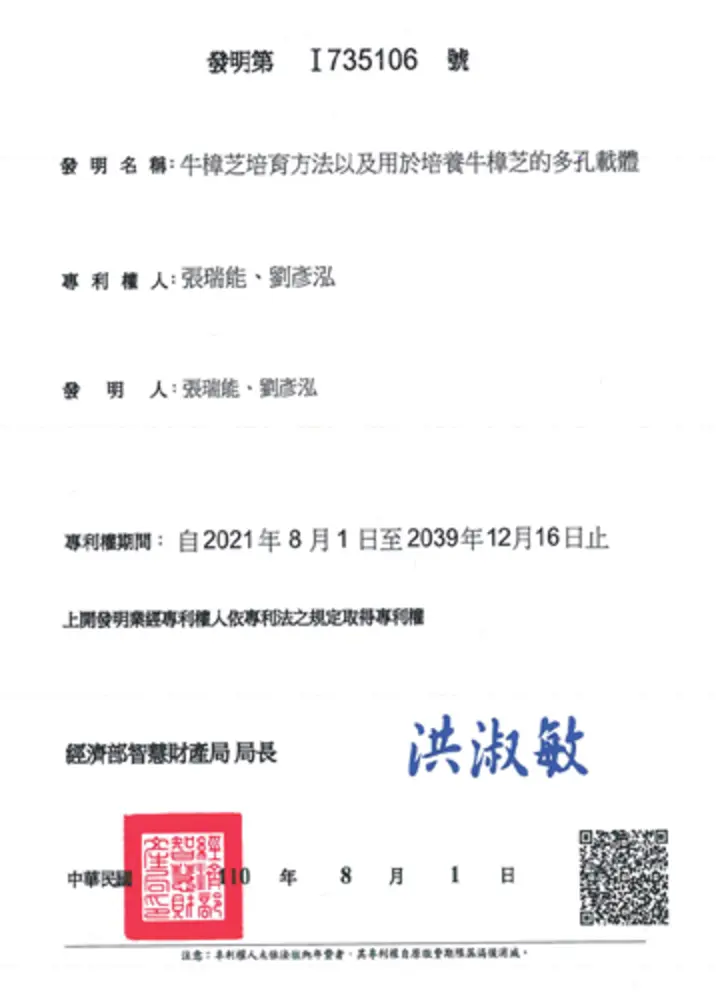 01 · TW
Antrodia cinnamomea cultivation method and porous carrier for cultivating Antrodia cinnamomea
Cultivation methods, a porous carrier, a nutrient layer and coating, and a controlled pathway for fruiting-body cultivation.
Public patent record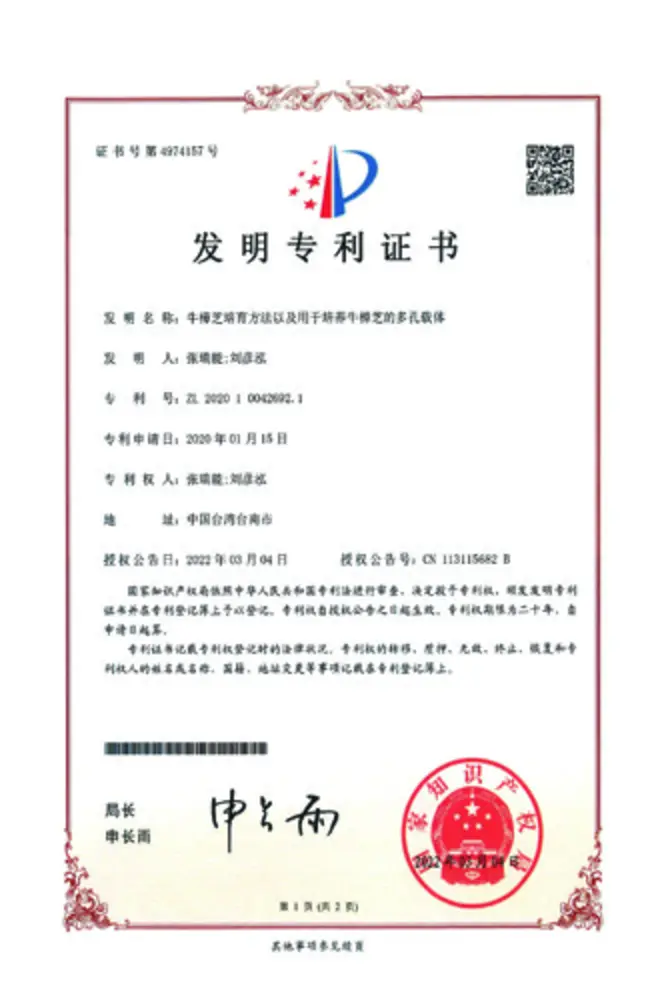 02 · CN
Antrodia cinnamomea cultivation method and porous carrier for cultivating Antrodia cinnamomea
Covers cultivation-method and porous-carrier technology.
Public patent record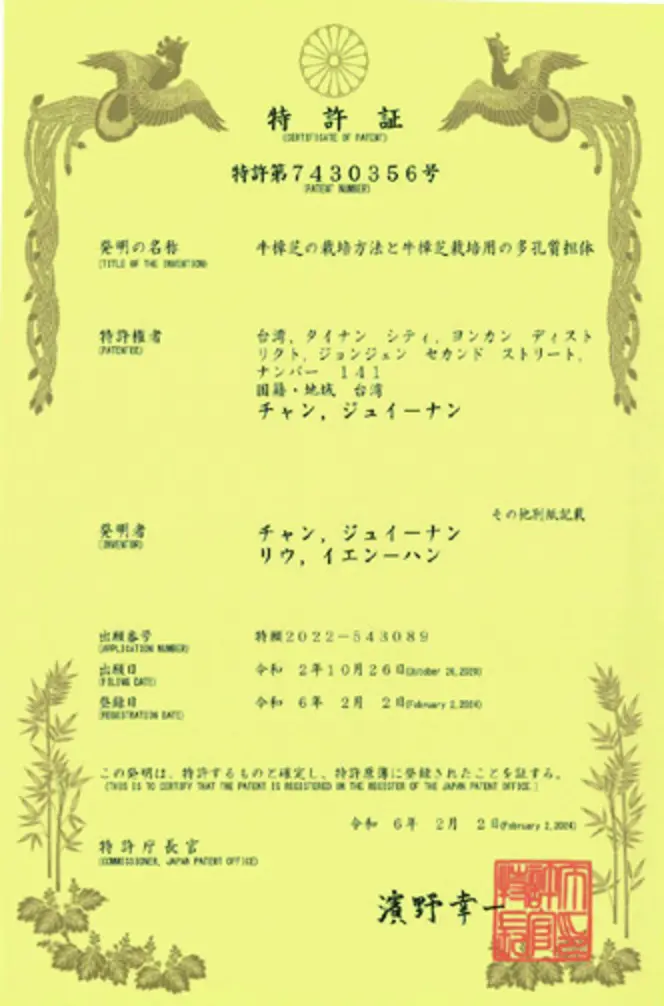 03 · JP
Antrodia cinnamomea cultivation method and porous carrier for cultivating Antrodia cinnamomea
Covers cultivation-method and porous-carrier technology.
Public patent record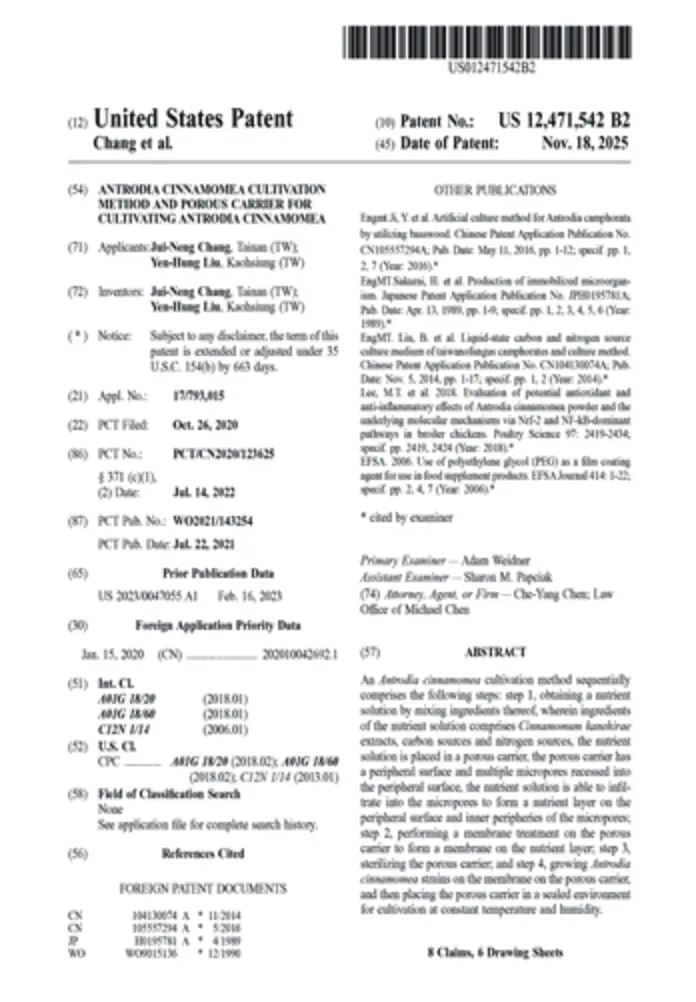 04 · US
Antrodia cinnamomea cultivation method and porous carrier for cultivating Antrodia cinnamomea
Covers cultivation-method and porous-carrier technology.
Public patent recordPublished research provides the molecular foundation; patent and process work supports source control, quality studies and future scale-up for TFA-01.
View TFA-01